Typhoid and Floating Power Plants in Sierra Leone
A Dispatch from an Advisor to the Mayor of Freetown
Starlight Convenience is a network of writers sharing reporting and speculative fiction on human endeavor in extreme conditions: settlement and industry, atmosphere and infrastructure, pockets of warmth and vitality encountered far from home. Our first post is from John Flory, an Advisor to the Mayor of Freetown, Sierra Leone.
As I write this, I am sitting in a fluorescent hospital room in the western district of Freetown. The walls are bare, three corners of the room are filled with mystifying assortments of medical supplies, the fourth has a toilet and a showerhead. A small curtained window looks out on the rest of the compound. I tested positive for typhoid two days ago, and am stuck here for at least the 48 hours it will take to finish my course of IV antibiotics.
tell you this not as an alarmist hook - typhoid seems to be a regular and typically misdiagnosed occurrence here, treated socially like the flu is in the developed world - but instead because I want you to know, as you read, the precise and peculiar sliver of Freetown you are getting. I cannot summarize this City in any meaningful sense, I can’t give any real interpretation of its culture or essence. I am not a microcosm of travelers’ experiences here, and I could not be further from the experience of an average Freetonian. All I can offer are the disconnected images and impressions of a 25-year-old who moved here about a month ago to work for the Mayor.
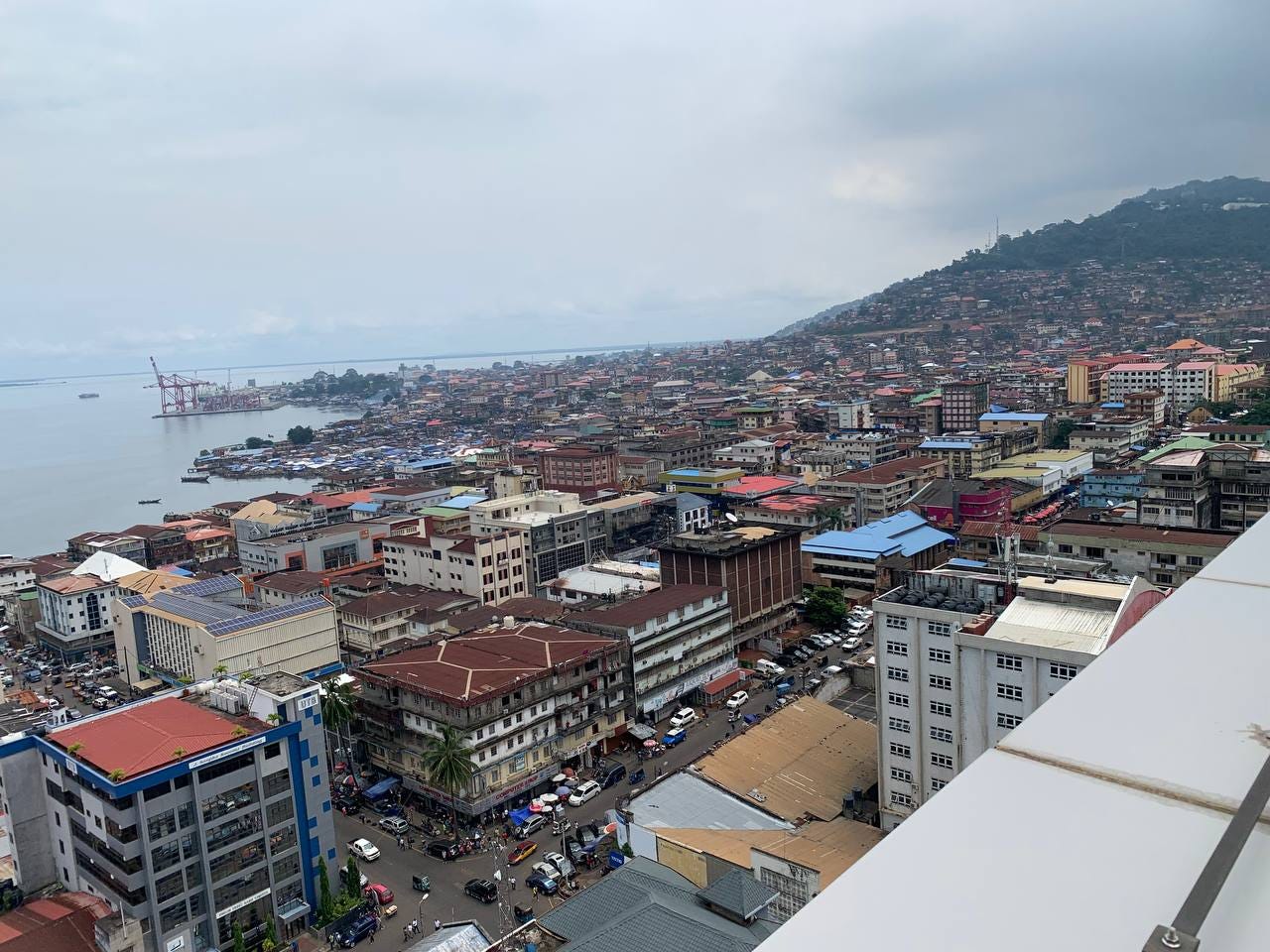
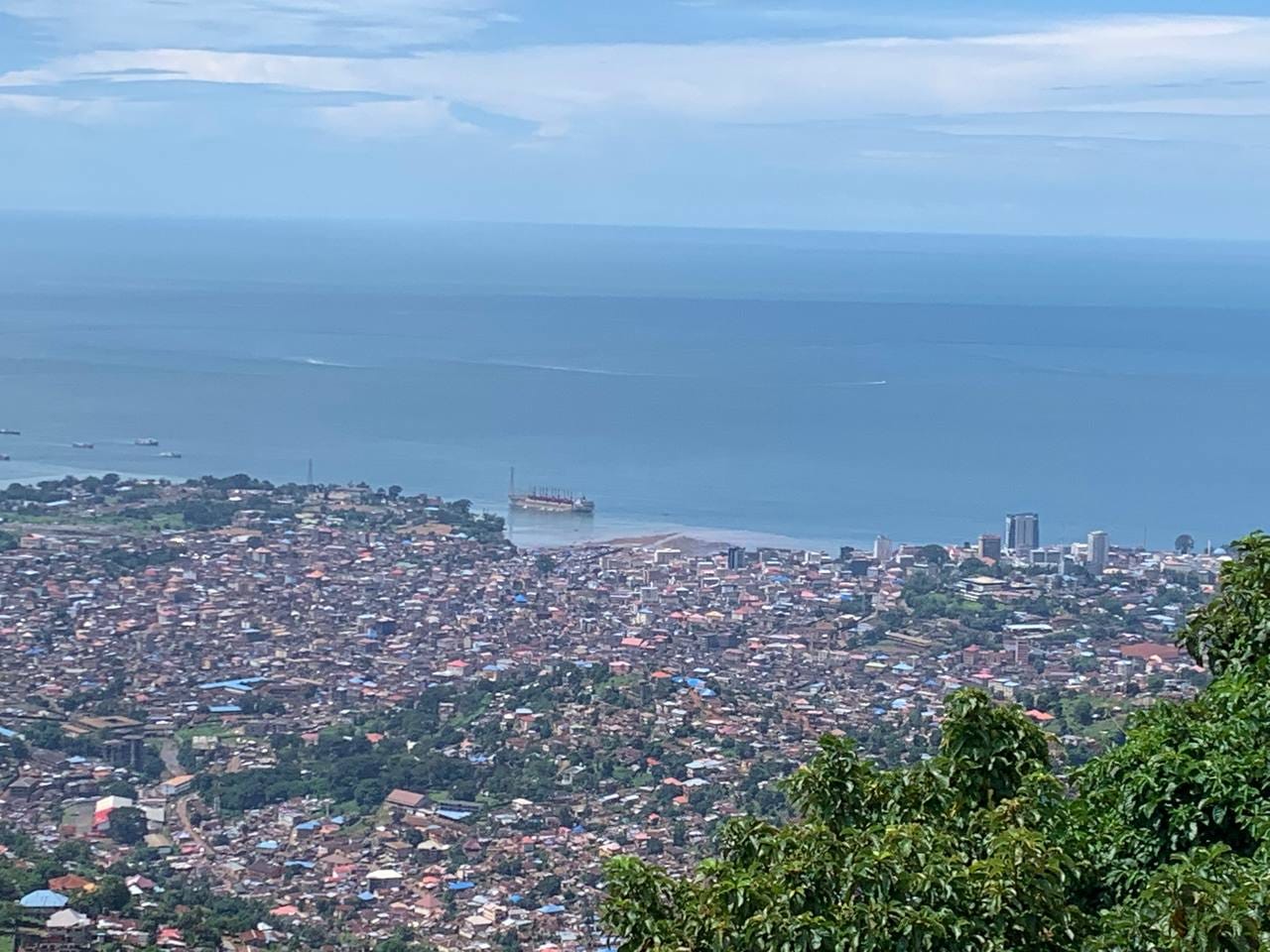
Geographically, Freetown occupies about 30 square miles squeezed between the ocean and the mountains. Embassies and formal housing settlements are nestled in the hills, where the air is cool and clear, the streets are quiet and mostly empty, and trees line the compounds. As you descend, the air warms by ten to fifteen degrees and thickens with a black smog that sputters from old trucks and rickshaws; the city roars with constant honking and yelling, and the streets fill with petty traders selling everything from dog collars to goats. Life bunches together as you approach the ocean, becoming denser and denser, as roads narrow and slums expand to the precipice of the water, which residents have pushed back with sand and soil and trash to keep themselves from falling off the city’s liquid edge.
Within these 30 square miles live at least 1.5 million people. These numbers, alone, mean nothing to us. So instead, imagine the space of Disney World filled to the point of bursting with as many people as live in San Francisco and Boston combined. Then strip away everything that might organize such an explosion of human life – sidewalks, traffic lights, a sewage system, retail stores, any street hierarchy, law. Only then do you begin to get a sense of the buzzing, unfettered chaos that is Freetown.
Let’s begin with law - the Metropolitan Police Force of Freetown has 136 officers patrolling its 1.5 million residents. (Boston, for comparison, has this many cops for every 5,000 people.) Members of this spartan force are paid about a dollar a day, and so can be bought for about as much. In lieu of any formal rule of law, crowds enforce public morality. At Lumley beach, I watched a man steal a phone from someone’s pocket. The victim screamed “Tiefman!”, pointed at the offender, and the crowd descended upon him. When they receded, the phone had been retrieved and the thief was mostly unharmed though, inexplicably, naked. In the Central Business District, I watched someone try to steal from a store. Again the store owner screamed “Tiefman!”, pointed at the offender, and again the object was retrieved and the thief was disrobed. Though imperfect, this system seems to work. I never feared crime in Sierra Leone, and truly the incidence of such offenses seems far lower than anywhere else I’ve lived.
The City, of course, has no public transportation, but it also has only the most skeletal system of roads. There are no addresses, no avenues or boulevards, no sidewalks or traffic lights, all because the City’s rate of expansion completely outstrips any attempt at imposing a street hierarchy or grid. The main means of navigating Freetown is a network of teenagers buzzing around the city on motorcycles. These figures are truly ubiquitous – faster than any Uber or yellow cab, you can flag down an ocada driver on the street, hop on the back of their bike, and for less than the cost of a subway ride they’ll drive you anywhere you can direct them. Every morning, I get to work by hailing a 17-year-old on a motorcycle, bracing myself behind his torso and screaming through traffic.
On my commute, I pass daily by the KAR Powership — a boat slightly smaller than a cruise ship moored within throwing distance of the coast – which provides the city’s entire energy supply. As you would imagine, powering an entire city from a boat creates several issues. Chief amongst these is the fact that when the City fails to pay its bill, the boat lifts anchor and floats away. At present the City owes the KAR Powership some $50M USD, and the boat will depart in a matter of days unless a down payment of “half” is paid. There is virtually no chance that the City manages to pay a bill equal to 1% of Sierra Leone’s annual GDP, but the electrical authority knows how to bluff, and is exceptionally skilled at finding the bare minimum it can pay to keep the lights on. And when it inevitably falls through, Freetown’s residents will piece together batteries and generators to keep the city incandescent and humming.
Freetown is a miracle, a stubborn, indefatigable drive to keep living in spite of catastrophically difficult conditions. Take New York, then strip away its police force, pull up the asphalt, twist the roads, cut the power, water, and flood the streets with 250,000 stray dogs. Would the City survive?
Freetown does. Told infinitely not to live, it goes on rebelliously, on the sheer grit and ingenuity of its residents. Over barking and honking and yelling, you hear constant, big-bellied laughter.